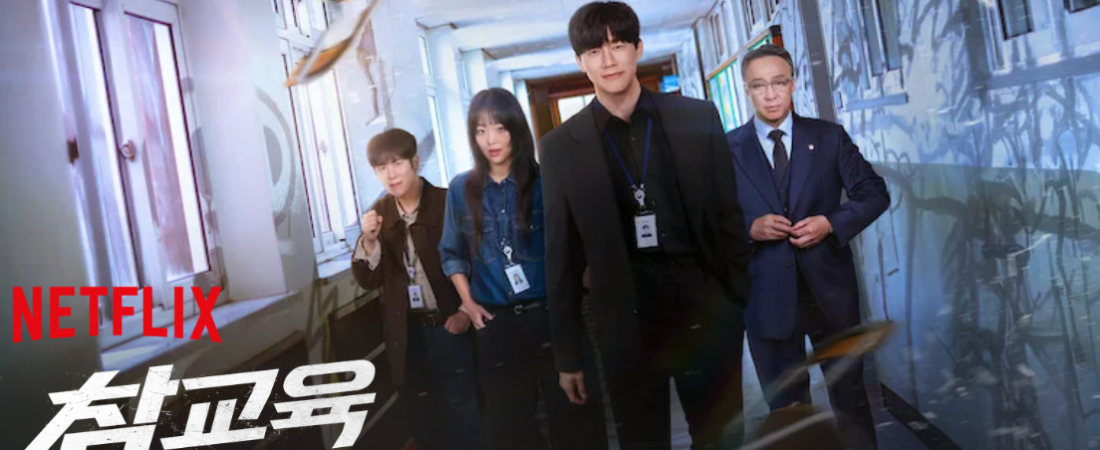
To international viewers, the premise of Netflix’s Teach You a Lesson may seem unusual. In the series, officers from a government agency called the Teacher Rights Protection Bureau enter schools and use extraordinary powers to deal with problems that the existing system has failed to resolve.
This exaggerated setup did not appear without a social context. Teach You a Lesson reflects decades of conflict in Korean schools over authority, student rights, corporal punishment, school violence, and complaints from parents. Rather than a realistic portrayal of the education system, it is better understood as a punishment fantasy shaped by public frustration with problems that schools have struggled to solve.
What Does “Teach You a Lesson” Mean in Korean?
The original Korean title, Chamgyoyuk (참교육), literally means “true education” or “proper education.”
On the Korean internet, however, the expression is often used with a different meaning. It can refer to severely punishing or humiliating someone who has behaved badly, supposedly to make sure that person never repeats the same behavior.
The title therefore carries two meanings. On the surface, it refers to restoring order in troubled schools. At the same time, it suggests the satisfaction of watching wrongdoers receive immediate and forceful punishment.
Teachers Once Held Considerable Authority in Korean Schools
In the past, teachers in Korea often held near-absolute authority over their students. Physical punishment and prolonged disciplinary exercises were sometimes accepted as normal parts of education.
Not every teacher used corporal punishment, but students generally found it difficult to challenge unfair or abusive treatment. Schools also imposed strict rules on hairstyles, clothing, personal expression, and privacy.
As criticism of this authoritarian school culture grew, more people began to argue that students should be protected by the same basic rights they had outside school.
The Ban on Corporal Punishment and the Expansion of Student Rights
In 2011, amendments to Korea’s education regulations prohibited teachers nationwide from directly inflicting physical pain on students through the use of objects or physical force.
Several regional governments also introduced student rights ordinances. These ordinances were intended to prevent corporal punishment and discrimination while protecting students’ privacy, freedom of expression, and other basic rights.
These reforms were necessary responses to violence and human rights abuses that had occurred in Korean schools. It would therefore be misleading to argue that banning corporal punishment or expanding student rights was itself a mistake.
The controversy concerns what happened afterward.
Once physical punishment was prohibited, debates continued over what teachers could legally and effectively do when students repeatedly disrupted lessons, threatened teachers, or assaulted other students.
Some teachers said they had become reluctant to intervene because they feared complaints from parents or accusations of child abuse. Others argued that schools and local education authorities often failed to protect teachers when serious conflicts occurred.
Did Student Rights Ordinances Cause the Teacher Rights Crisis?
Student rights ordinances are frequently blamed when concerns about teacher authority are discussed in Korea. Critics argue that the ordinances emphasized student rights while weakening teachers’ ability to maintain discipline.
However, the teacher rights crisis cannot be explained by these ordinances alone. Complaints from parents and violations of teachers’ rights also occurred in regions without student rights ordinances. Concerns about declining teacher authority had already appeared before the ordinances were introduced.
Broader changes in Korean society also played a role. Education increasingly came to be viewed as a service, with students and parents treated as consumers and teachers as service providers. In some cases, parental demands began to carry more weight than teachers’ professional judgment.
School violence, intense academic competition, online complaints, public pressure, and weak administrative support for teachers all contributed to the problem.
The central issue was therefore not simply that students had been given too many rights. The problem was that the system did not develop sufficiently clear and effective nonviolent methods for teachers to protect lessons, respond to serious misconduct, and defend the rights of other students.
The Teacher Rights Debate Intensified After 2023
In 2023, the death of an elementary school teacher in Seoul brought national attention to the working conditions faced by Korean teachers.
Large numbers of teachers joined public demonstrations, calling for stronger protection from abusive complaints by parents and indiscriminate accusations of child abuse.
The Korean government subsequently introduced measures intended to distinguish legitimate student guidance from child abuse, improve complaint-handling systems, and allow schools to separate students whose behavior seriously disrupts lessons.
The original webtoon of Teach You a Lesson began publication in 2020, before the 2023 incident. However, the concerns it raised about declining teacher authority and the inability of schools to resolve serious problems became much more prominent in Korean society after 2023.
Why Did Such a Powerful Punishment Fantasy Emerge?
In reality, cases involving school violence, abusive parents, or serious classroom disruption can take a long time to resolve. Schools, local education offices, police, and courts may all follow separate procedures.
During that process, victims may feel that they are not being protected and that offenders are avoiding meaningful consequences.
Teach You a Lesson removes those complicated procedures. Powerful investigators enter the school, immediately confront the wrongdoers, and punish not only violent students but also adults who abuse their authority or refuse to take responsibility.
Such methods would be unacceptable and often illegal in real life. However, they can provide a sense of emotional release for viewers who believe that existing institutions are too slow or too weak to protect victims.
The series is therefore better understood as a fantasy in which an outside authority solves problems that the real education system has failed to address, rather than as a realistic proposal for school reform.
The Netflix Adaptation Does Not Present Students as the Only Problem
The original webtoon begins with the premise that teacher authority collapsed after the ban on corporal punishment. Its scenes of violent punishment and some of its character portrayals also generated controversy in Korea and abroad.
The Netflix adaptation keeps the central idea of the Teacher Rights Protection Bureau but expands the range of people held responsible. According to the series’ official description, the investigators deal not only with students who cross the line, but also with parents and teachers who abuse their power.
The drama is therefore not simply a story claiming that students have gained too many rights. Instead, it presents an outside agency that punishes anyone within the school system—students, parents, or teachers—who harms others or exploits their position.
What the Drama Reveals About Korean Society
Teach You a Lesson is not a documentary about Korean schools. No agency like the Teacher Rights Protection Bureau exists in Korea, and teachers are not legally permitted to use violence against students.
Nevertheless, the series emerged from real social tensions.
In the past, teachers often held excessive power, and students sometimes suffered corporal punishment and violations of their rights. Later, stronger protections for students were introduced. At the same time, dissatisfaction grew over whether teachers had been given adequate legal authority and institutional support to respond to school violence, severe classroom disruption, and abusive complaints from parents.
The drama reflects a broader question facing Korean society: how can the education system protect one group’s rights without leaving another group unable to perform its responsibilities?
The real issue is not whether Korea should choose between student rights and teacher rights. It is how to build a system in which students are protected from violence and discrimination, while teachers can maintain a functioning classroom and protect the right of other students to learn.